
Facebook Ad Formats: Every Type Explained (Examples)
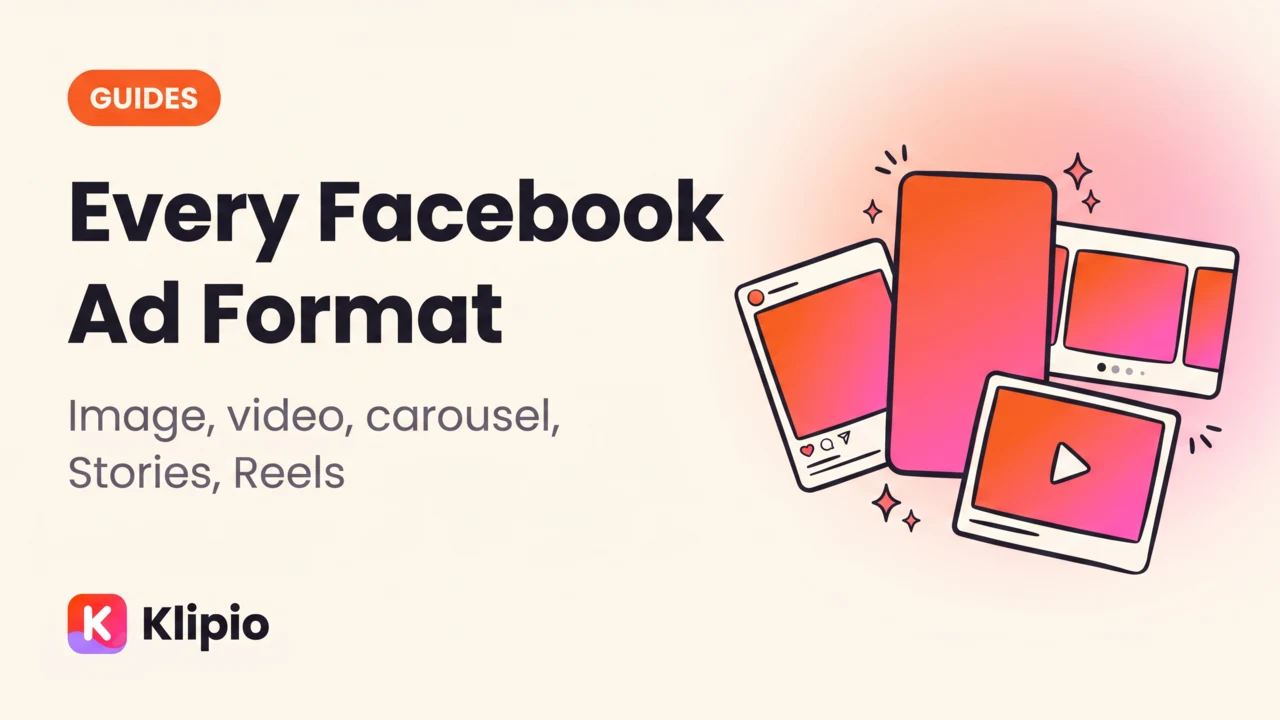
There are six core Facebook ad formats: single image, single video, carousel, Collection, Instant Experience, and slideshow. Each Facebook ad format is built for a different placement and a different job, from a five-second Stories flash to a scrollable ten-card carousel.
This guide breaks down every format, the sizes each one needs, and which one to reach for depending on what you're actually advertising.
What are Facebook ad formats, exactly?
A format is the shape and structure Meta wraps around your creative, not the creative itself. The same product photo can run as a single image ad, one card in a carousel, or the cover of a Collection.
Meta ad formats aren't optional skins. Each one changes what you're allowed to include — one image versus ten cards, a static frame versus a scrolling catalog — and where it's eligible to run. Pick the wrong format and the platform simply won't show your ad in the placement you wanted.
Format is also separate from placement. Placement is where an ad appears (Feed, Stories, Reels, Marketplace). Format is what shape the ad takes once it's there. Most formats can run across several placements; a few, like Collection, are locked to mobile feed only.
The 6 core Facebook ad formats explained
| Format | Best for | Card/element limit | Typical placements |
|---|---|---|---|
| Single image | Fast tests, clear one-product offers | 1 image | Feed, Marketplace, right column |
| Single video | Demos, storytelling, brand awareness | 1 video | Feed, Stories, Reels, in-stream |
| Carousel | Multiple products, before/after, steps | 2–10 cards | Feed, Marketplace |
| Collection | Mobile catalog browsing | Cover image/video + product grid | Feed (mobile only) |
| Instant Experience | Full-screen post-tap landing page | Multiple stacked blocks | Opens from feed, Collection, video ads |
| Slideshow | Lightweight video alternative | 3–10 images | Feed, low-bandwidth regions |
Single image is still the fastest format to test. One photo, one headline, one link. It's the default starting point for a new offer because there's nothing to build beyond the image itself.
Single video carries the most information per second — motion, sound, a voiceover doing the selling for you. It's also the format most placements now favor by default, since Stories and Reels are video-first.
Carousel is the underrated workhorse. Carousel ads can hold 2 to 10 cards, each with its own image or video, headline, and link, so you can show a full product range or walk someone through a before-and-after in one ad unit. It regularly outperforms single image for catalogs and multi-benefit products, because people scroll it like a mini gallery instead of glancing once.
Collection pairs a cover image or video with a grid of product images below it. Tapping any product opens an Instant Experience — a full-screen, app-like browsing layer — without leaving Facebook or Instagram. It's mobile-only by design.
Instant Experience isn't a standalone placement you pick; it's the full-screen layer that opens after someone taps a Collection ad, a video ad, or certain carousel ads. Think of it as a fast, swipeable mini landing page built with Meta's own blocks.
Slideshow turns 3 to 10 static images into a lightweight looping video. It's mainly useful where video hosting or bandwidth is a constraint, since it renders far smaller than an actual video file.
Which Meta ad format should you use?
Format choice comes down to what the creative needs to do. A single hero shot with a clear price and a strong headline doesn't need a carousel wrapped around it.
A product with five colorways, or a routine with three steps, needs the room a carousel gives it. Trying to cram that into one image usually means cramming text onto the image too, which hurts clarity more than it helps.
Anything that depends on movement, sound, or pacing, a demo, an unboxing, a testimonial, belongs in video. Static formats can imply motion; video actually shows it.
Facebook ad sizes and specs by placement
Facebook ad sizes vary by where the ad runs, not just by format. Getting the aspect ratio wrong is the single most common reason a good ad looks cropped or badly framed.
| Placement | Recommended ratio | Notes |
|---|---|---|
| Feed (image or video) | 1:1 or 4:5 | Square and portrait both outperform landscape in-feed |
| Stories | 9:16 | Full-screen vertical, safe zones for text near top/bottom |
| Reels | 9:16 | Same vertical canvas as Stories; feels native to the format |
| Marketplace | 1:1 | Square crops cleanest in the grid layout |
| Right column (desktop) | 1:1 | Small, low-emphasis placement, largely legacy |
| Carousel cards | 1:1 | Each card crops the same way, so consistency matters |
Stories, Reels, and other placement-specific formats
Stories and Reels ads use the same underlying formats (image, video, carousel) but wrapped for a full-screen 9:16 vertical canvas instead of a scrolling feed. There's no headline sitting beside the image; text has to live inside the frame.
Reels ads specifically get skipped past fast, so the opening one to two seconds carry more weight than in any feed placement. A slow logo intro that works fine in a feed video usually costs you the whole impression in Reels.
Marketplace ads mostly reuse single image and carousel formats, cropped into a shopping grid. It's a lower-effort placement to design for since the visual expectations are closer to a product photo than a lifestyle ad.
How to find real examples of every format
The fastest way to see every Facebook ad format in the wild, not in a spec sheet, is the Meta Ad Library at facebook.com/ads/library. It's free, needs no account, and shows every active ad from any advertiser worldwide. For a full walkthrough of using it, see our Meta Ad Library guide.
Search a competitor and you'll see their current mix of single image, video, and carousel ads side by side, plus each ad's "Started running on" date. That date matters more than it looks: ad longevity is the closest signal outsiders get to which format and creative is actually working, since normal commercial ads don't expose spend or engagement. Our piece on seeing any competitor's Facebook ads covers how to read that signal properly.
For a curated set of formats worth studying, our roundup of strong Facebook ad examples breaks down what makes specific carousels, videos, and Collection ads work, not just what format they used. And if the format question is really a creative question, our guide to what ad creative actually is covers the difference between the format wrapper and the creative inside it.
One gap in the Ad Library: there's no download button, and nothing sticks around once an advertiser pauses it. Disclosure: we built a free Chrome extension for that. The Klipio Meta Ad Library Downloader adds a download button to every ad in the library, pulls full carousels card by card, and can bulk-collect an entire search into one organized ZIP. It's free, needs no account, and runs in your own browser.
FAQ
What are the different types of Facebook ads?
The core Facebook ad types are single image, single video, carousel, Collection, Instant Experience, and slideshow. Stories and Reels use the same formats wrapped for a vertical, full-screen canvas.
What is the best Facebook ad format for ecommerce?
Carousel tends to perform best for ecommerce because it can show multiple products, colors, or a before-and-after in one ad unit. Single image still wins for fast, cheap testing of a single clear offer.
What size should a Facebook ad be?
Feed placements do best at 1:1 (square) or 4:5 (portrait). Stories and Reels need full 9:16 vertical creative, since anything landscape gets cropped or letterboxed on that canvas.
What is a Collection ad on Facebook?
A Collection ad is a mobile-only format that pairs a cover image or video with a grid of product images underneath it. Tapping any product opens an Instant Experience, a full-screen browsing layer, without leaving the app.
How many images can a carousel ad have?
A carousel ad can have between 2 and 10 cards, and each card carries its own image or video, headline, and link. That makes it the format with the most room to show range without building a separate landing page.
Do Facebook ad formats affect cost?
Format doesn't set price directly, but it affects how well your ad matches the placement, which feeds into Meta's ad auction and relevance signals. A landscape video crammed into a vertical Reels slot typically gets less engagement, and less engagement usually means a worse cost per result.
The Klipio extension adds a download button to every ad in the Meta Ad Library: one click per ad, or bulk-save a whole search as a ZIP with a searchable swipe file inside. Free, no sign-up.
Get the free Ad Library downloaderKlipio reads a competitor's live Meta ads, ranks them by how long they have been running — the honest signal that an ad is profitable — and turns the winning angle into on-brand creative for your own brand. 3-day free trial.
Start free — 3-day trial →