
Google Ads vs Facebook Ads: Which Should You Run?
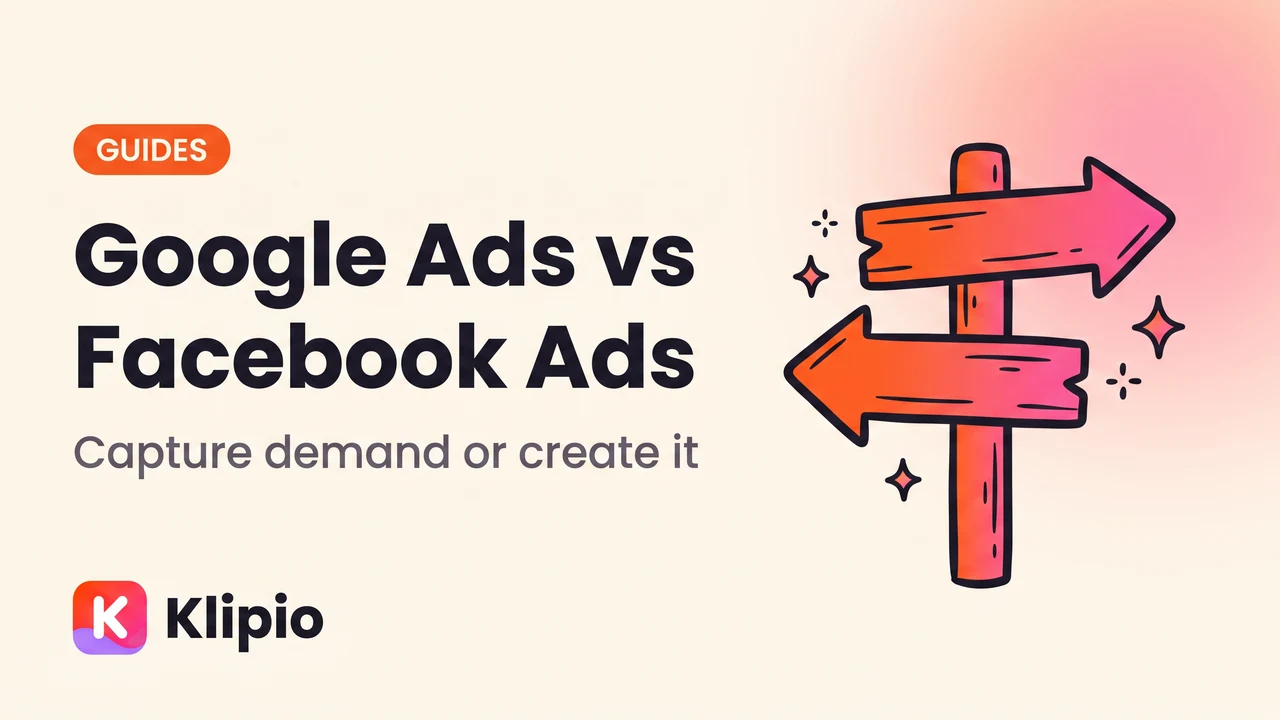
Google Ads captures demand that already exists; Meta ads create demand that doesn't. That single distinction answers the question for most businesses: if people are already searching for what you sell, start with Google. If they don't know your product category exists, start with Meta. Everything else is refinement.
The framing people usually reach for — "which is cheaper" or "which has better ROAS" — produces bad decisions, because the two platforms are doing different jobs at different points in the same funnel.
What's the actual difference in intent?
On Google, someone types "waterproof hiking boots size 10" into a search box. They've already decided they want the thing. The advertiser's job is to be present and be the obvious choice. The demand was there before the ad.
On Meta, someone is scrolling through photos of their friends' weekends. They weren't thinking about hiking boots. The advertiser's job is to interrupt them with something interesting enough to create the want. The demand didn't exist ten seconds ago.
That difference cascades into everything:
| Google Ads | Meta ads | |
|---|---|---|
| Demand | Captures existing | Creates new |
| Targeting basis | Keywords, i.e. stated intent | Interests, behaviour, lookalikes |
| Main lever | Keywords, bidding, landing page | Creative |
| Typical cost shape | Higher cost per click | Lower cost per impression |
| Conversion rate | Usually higher | Usually lower |
| Ceiling | Capped by search volume | Capped by audience size and creative |
| Time to first result | Fast if keywords exist | Needs creative testing first |
| Creative burnout | Slow | Fast |
Which is cheaper?
The wrong question, but the honest answer is: Google costs more per click and Meta costs more in creative labour.
Google's high-intent keywords are expensive precisely because they work. Commercial terms in competitive categories, especially legal, finance and insurance, run into serious money per click. You're paying for someone who has already decided to buy.
Meta's cost per thousand impressions is comparatively low, but you're paying to reach people who weren't looking. Conversion rates are lower by nature, and the cost that doesn't appear on the invoice is creative production: you'll need a steady supply of new ads because creative fatigue is real and fast on Meta in a way it isn't in search.
Compare the two on cost per acquisition against your margin, never on cost per click or CPM. And compare on blended returns rather than platform-reported ones, since both platforms claim credit generously; blended versus platform ROAS covers why the two numbers rarely agree.
Which should you start with?
Run this test.
Is there meaningful search volume for what you sell? Open Google Keyword Planner (free with a Google Ads account) and check. Type the terms a customer would use, not your internal product names.
- High volume, clear commercial intent — "emergency plumber Bristol", "running shoes", "CRM software". Start with Google. The demand exists; go collect it.
- Low or no volume, because the category is new or the need is latent — a product people don't know they want, an impulse purchase, a lifestyle brand. Start with Meta. Nobody is searching for a thing they've never heard of.
- Volume exists but you can't afford the clicks. Start with Meta to build brand recognition and remarketing pools cheaply, then move into search once your conversion rate can justify the click price.
A second test that cuts through a lot of debate: is the purchase urgent? Urgent needs (broken boiler, locked out, sick pet) live on Google, because people search the moment the need appears. Discretionary and discovered purchases live on Meta.
What does each platform demand from you?
This is the practical difference that decides whether you'll succeed, and it's underrated.
Google demands structure. Keyword research, match types, negative keywords, ad group organisation, landing pages that match search intent, and conversion tracking that works. It rewards patient, systematic people. Creative matters less: a well-structured account with plain text ads beats a badly structured one with brilliant copy.
Meta demands creative. Volume of it, and variety. The account structure should be boring and consolidated; the creative is where the wins come from. It rewards people who can produce, test and kill ads quickly. A brilliant account structure with weak creative goes nowhere on Meta.
Ask honestly which of those you have. An agency-free founder who can shoot decent video on a phone is better suited to Meta. A methodical operator with a good site and no creative resource is better suited to Google.
Can you run both at once?
Eventually you should, but not on day one with a small budget.
Splitting a limited budget across two platforms means neither gets enough data to optimise. Meta needs enough conversions per week for its delivery system to learn; Google needs enough clicks to identify which keywords convert. Half a budget on each usually means both stay in the noisy, expensive phase indefinitely.
The sensible sequence:
- Pick the platform your intent test points to. Fund it properly until it's stable and profitable.
- Add branded search on Google early, even if you're Meta-first. It's cheap, it protects against competitors bidding on your name, and it catches people who saw your Meta ad and then searched for you. This is the single highest-return small spend in paid media.
- Add the second platform properly once the first is stable, and expect the attribution picture to get messier. Meta creates demand that then converts through Google search, which means Google will look better than it is and Meta worse. Watch blended numbers.
That last point is why people mistakenly conclude "Google is better" after adding search to a working Meta account. They're often measuring the same customer twice.
How do you research either platform before spending?
Both have free, official transparency products, and using them before you launch is the cheapest research available.
Meta: the Meta Ad Library shows every active ad from every advertiser worldwide, with each ad's "Started running on" date. Since advertisers kill losing ads within days, ads running 60 to 90+ days are proven winners. Pull the long-running ads from five competitors and you have the market's working angles before you spend anything.
Google: the Ads Transparency Center shows every ad from any verified advertiser — search text, display, YouTube, Shopping — with regions and dates. It won't show keywords or spend, but it shows offers and positioning clearly. The full method is in checking competitors' Google Ads.
Neither has a download button, and Meta's library forgets ads permanently once they stop running. Our free extension, Klipio's Meta Ad Library Downloader, fixes that side: a download button on every ad, plus a bulk mode that packs a whole search into one ZIP with a searchable swipe board and a CSV (disclosure: Klipio is our product; free, no account, runs in your browser). The workflow is in downloading Facebook Ad Library videos.
FAQ
Is Google Ads or Facebook Ads better?
Neither, in the abstract. Google captures demand that already exists through search, so it wins when people actively look for what you sell. Meta creates demand through interruption, so it wins for products people don't know they want. Check whether meaningful search volume exists for your category, and let that decide.
Which is cheaper, Google Ads or Facebook Ads?
Google generally costs more per click because you're buying high intent; Meta generally costs less per impression but converts at a lower rate and requires ongoing creative production. Compare them on cost per acquisition against your margin rather than on click or impression cost, and use blended returns rather than each platform's self-reported numbers.
Should a small business start with Google or Facebook?
Local and urgent services — plumbers, dentists, locksmiths, lawyers — should start with Google, because people search at the moment of need. Visual consumer products and new categories should start with Meta. Whichever you choose, add branded search on Google early: it's cheap and protects your own name.
Can you run both at once?
Yes, but not on a small budget from day one. Splitting a limited budget means neither platform gathers enough data to optimise, so both stay expensive. Fund one properly until it's stable, add branded search early, then add the second platform and watch blended numbers, since Meta-created demand often converts through Google search and distorts per-platform attribution.
Which platform is better for ecommerce?
Most ecommerce brands end up on both, with the starting point set by category awareness. Established product categories with search volume (running shoes, coffee machines) justify Google-first, including Shopping. New or impulse products need Meta to create the demand first. Meta usually carries the discovery load and Google captures the resulting searches.
The Klipio extension adds a download button to every ad in the Meta Ad Library: one click per ad, or bulk-save a whole search as a ZIP with a searchable swipe file inside. Free, no sign-up.
Get the free Ad Library downloaderKlipio reads a competitor's live Meta ads, ranks them by how long they have been running — the honest signal that an ad is profitable — and turns the winning angle into on-brand creative for your own brand. 3-day free trial.
Start free — 3-day trial →