
Creative Fatigue: What It Is and How to Spot It on Meta
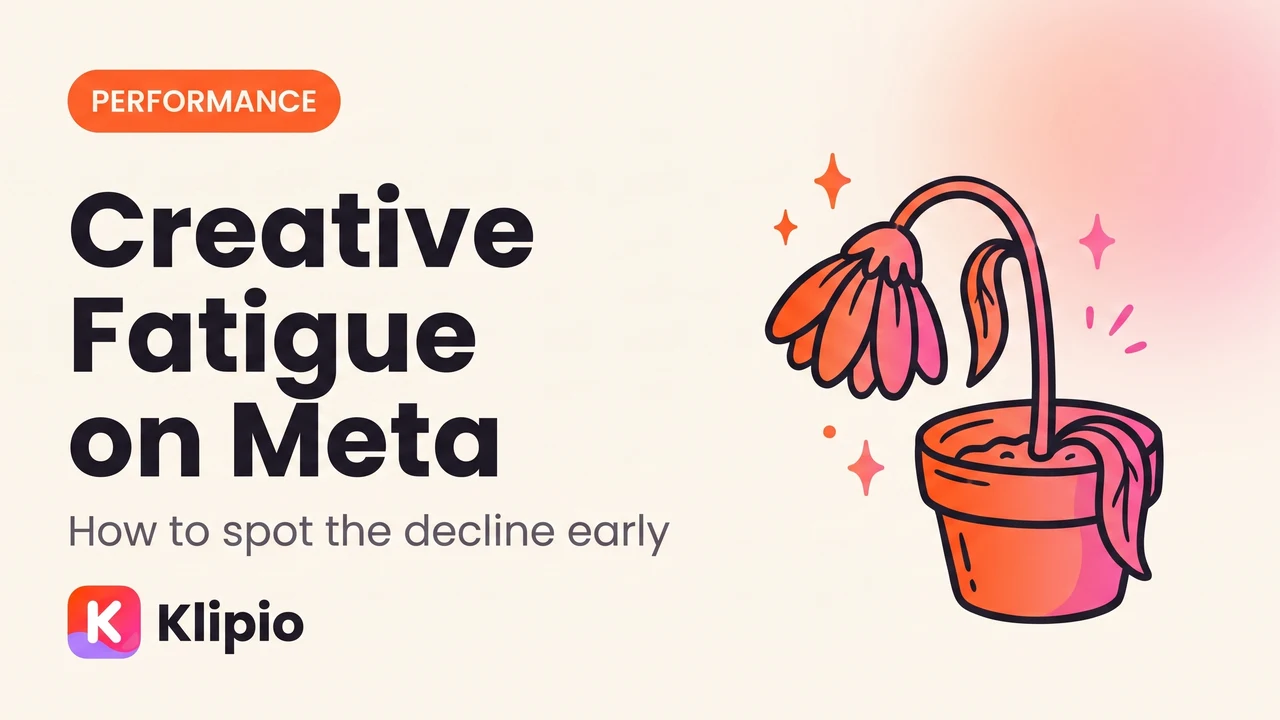
Creative fatigue is what happens when Meta shows the same ad to the same audience too many times: engagement drops, cost climbs, and nothing about your targeting or offer has changed. You can catch it early by watching three numbers move together — link CTR falling, frequency rising, and CPM increasing — usually days before it shows up as a damaged CPA.
This post covers the definition, the pattern to watch for, which signals lead and which lag, and how to build the columns that make creative fatigue visible instead of something you notice after the budget's gone.
What is creative fatigue?
Creative fatigue is the decline in an ad's performance that happens purely from an audience seeing it too many times, independent of the offer, targeting, or market changing underneath it. Every additional impression to the same eyes earns less attention and costs more to buy.
Meta doesn't publish an official definition or fatigue score. The pattern below is how experienced media buyers (and agencies like Motion and Common Thread Collective, whose data this article draws on) diagnose it, and it holds up across accounts even though exact numbers vary.
The canonical pattern is three metrics moving together: link click-through rate (CTR) declining, frequency rising, and CPM increasing. Any one of those alone could mean something else — a seasonal CPM spike, a bad landing page, a slow week. All three moving the same direction, on the same ad, is fatigue.
What causes creative fatigue on Meta?
The mechanical cause: Meta has a finite pool of people it's willing to show your ad to at a given budget and bid. Once it's shown the ad to most of that pool more than once, the "first-time-impression ratio" (the share of impressions reaching someone seeing the ad for the first time) falls. Frequency rises because Meta is re-showing the ad to people who already saw it, not because it found new people.
Repetition does the rest. The tenth time someone sees the same hook, they scroll past faster, and some start hiding the ad or leaving negative feedback, which Meta's ad-quality signal also picks up.
Since Andromeda (Meta's 2024 creative-reading retrieval system), this has gotten sharper. Meta is reported to read the creative itself — hook, format, copy, tone — when deciding who to show an ad to, the industry's basis for "creative is the new targeting." A stale creative isn't just tired to viewers; it's a weaker signal for Meta's own delivery system.
What are the leading signs of creative fatigue?
Leading signals move first, before the damage is fully priced into your cost columns. Catching these gives you time to react before CPA visibly suffers.
- Link CTR decline. A 10-15% week-over-week drop is an early warning; 20%+ sustained over two weeks is a confirmed decline. This is usually the earliest tell, often showing up 3-5 days before frequency crosses a warning threshold.
- Frequency rising. For prospecting (cold) campaigns: 2.0-2.5 is worth watching, 2.5-3.0 is a flag, 3.0-4.0 is danger territory, and 4+ is critical. Retargeting audiences behave differently — they tolerate 4-6, and a hot retargeting pool can run 8-12 per week without the same fatigue signature.
- Hook rate and hold rate falling, measured against the ad's own baseline, not an industry number. A video that used to hook 35% of viewers and now hooks 22% is telling you something before link CTR fully reflects it.
- First-time-impression ratio dropping. This is the underlying cause of rising frequency — Meta running out of new people to show the ad to.
- Negative feedback ticking up (hides, "why am I seeing this" clicks). Small numbers, but a leading indicator of ad quality decay.
What are the lagging signs of creative fatigue?
Lagging signals confirm what the leading signals already warned you about. By the time these move, you've usually already spent the money.
- CPM rising 15-20%+ on the same audience, outside of Q4/BFCM seasonal pressure that would raise CPMs for everyone.
- CPA, or cost per result, creeping up, typically visible in the days 10-20 window of a creative's life.
- Conversion rate (CVR) declining while traffic volume stays steady — you're buying the same clicks for more money and converting fewer of them.
How fast does creative fatigue set in?
Speed depends mostly on audience size. Smaller audiences (under roughly 500K) can fatigue in 1-2 weeks; larger audiences take 3-4 weeks. Retargeting audiences, being smallest and most repeatedly exposed, fatigue fastest of all — though as noted above, they also tolerate much higher frequency before it matters.
Advantage+ changes the timeline. Because Meta's system concentrates spend on whatever creative is currently winning, a strong ad under Advantage+ can burn out in 2-3 weeks. Agencies tracking this (Common Thread Collective) describe overall ad lifespan compressing from roughly 6-8 weeks pre-Andromeda to 2-4 weeks now — a reported, agency-observed shift, not a Meta-published number, but consistent with what most buyers running Advantage+ campaigns see.
A rough timeline for one creative on one audience: days 1-5 usually hold strong, days 5-10 is when link CTR starts declining, days 10-20 is when CPA creeps, and by day 20+ the drop is usually significant. Most winning creatives peak somewhere in the days 7-21 window before decline sets in.
Prospecting vs. retargeting: how do fatigue thresholds differ?
The same frequency number means very different things depending on which audience you're feeding.
| Signal | Prospecting (cold) | Retargeting |
|---|---|---|
| Frequency to watch | 2.0-2.5 | Tolerates 4-6 |
| Frequency flag | 2.5-3.0 | — |
| Frequency danger | 3.0-4.0 | Hot audiences run 8-12/week |
| Frequency critical | 4+ | Rarely critical at these levels |
| Typical time to fatigue | 1-4 weeks (audience-size dependent) | Fastest to repeat exposure, but tolerant of it |
How do you see creative fatigue in Ads Manager?
Four setup steps make the pattern visible instead of something you infer after the fact.
- Add Frequency at the ad level, not just campaign or account level. Fatigue is a per-creative phenomenon; an account-level average hides it.
- Break down by time (day or week), not lifetime average. A lifetime average smooths a ten-day decline into an unremarkable number. Use Breakdown → By Time to see the trend.
- Add a placement breakdown. An ad can be fatigued on Reels and fresh on Feed at the same moment; averaging placements together hides that.
- Watch CPM outside Q4/BFCM. Seasonal CPM inflation affects every advertiser at once and isn't fatigue — comparing CPM trend during a normal month isolates the real signal.
A workable rule of thumb some buyers use: pause when 3-day link CTR is down 30%+ against the trailing 14-day average, with a floor of at least 1,000 impressions so you're not reacting to noise on a tiny sample.
How do you fix creative fatigue once you've spotted it?
Short version: reach for a new angle before a new hook, and a new hook before a new format. A new angle changes the actual reason-to-buy and can reach a genuinely different slice of the audience. A new hook — the first three seconds of video or the opening line of copy — is the fastest lever on link CTR, sometimes doubling it outright.
A new format (static to UGC, UGC to Reels, image to carousel) is the next lever down. Repainting the same ad in a different color rarely resets anything, because angle and hook are what the audience actually reacted to.
The durable fix isn't one swap, it's volume. Accounts shipping 20+ genuinely distinct new ads a month report roughly 65% higher ROAS than accounts under 10 (vendor-reported, correlational, not causal, but directionally consistent). The full playbook — testing structures, hook matrices, budgeting the refresh — is in how to fix creative fatigue.
Finding new angles is the hard part, and that's where competitor research earns its keep. Meta's Ad Library shows no spend data, but ad longevity — how long an ad has kept running — is the closest public proxy for "this hasn't fatigued and is still making money." An ad live 60-90 days survived someone else's real budget review, repeatedly.
We cover reading that signal in reading ad longevity to spot winners, and the routine that feeds it in how to see your competitors' Facebook ads.
Disclosure: this is where our product fits. Klipio is Meta-only ad intelligence — it watches competitors' live Meta ads, surfaces the longest-running as likely winners, and turns the angle behind them into on-brand creative you can ship. The free version, Klipio's Meta Ad Library Downloader, adds a download button to every ad in the public Ad Library, no account needed. Paid plans, which automate the angle-mining and creative generation, start at $79/mo.
FAQ
What is creative fatigue in Facebook ads?
Creative fatigue is the drop in an ad's performance caused purely by an audience seeing it too many times, not by a targeting, offer, or market change. The tell is link CTR falling while frequency and CPM rise on the same ad, on the same audience.
What frequency is too high for Facebook ads?
For prospecting (cold) audiences, 2.5-3.0 is a flag, 3.0-4.0 is danger, and 4+ is critical. Retargeting audiences are different — they tolerate 4-6, and a hot retargeting pool can sit at 8-12 per week without the same damage. These are agency benchmarks, not Meta-published rules, so treat them as a starting point and baseline against your own account.
How long does it take for a Facebook ad to fatigue?
It depends mostly on audience size: under about 500K people can fatigue in 1-2 weeks, larger audiences in 3-4 weeks. Advantage+ campaigns often compress this further, to 2-4 weeks, because Meta's system concentrates spend hard on whatever creative is currently winning.
What's the first sign of ad fatigue, before CPA goes up?
Link CTR (link click-through rate, not CTR-all) is usually the earliest tell — a 10-15% week-over-week drop can show up 3-5 days before frequency even crosses a warning threshold. By the time CPM and CPA move, you're already several days into the decline.
Does creative fatigue affect retargeting the same way as cold audiences?
No. Retargeting audiences are smaller and see your ads more often by design, so they tolerate much higher frequency — 4-6 as a norm, up to 8-12 per week for hot audiences — without the same fatigue signature cold prospecting shows at those numbers.
How do you fix creative fatigue?
Reach for a new angle first, since it changes the actual reason-to-buy; a new hook second, since it's the fastest lever on link CTR; and a new format third. The durable fix is a repeatable pipeline of genuinely distinct new creative, not repainting the same ad. The full framework is in how to fix creative fatigue.
The Klipio extension adds a download button to every ad in the Meta Ad Library: one click per ad, or bulk-save a whole search as a ZIP with a searchable swipe file inside. Free, no sign-up.
Get the free Ad Library downloaderKlipio reads a competitor's live Meta ads, ranks them by how long they have been running — the honest signal that an ad is profitable — and turns the winning angle into on-brand creative for your own brand. 3-day free trial.
Start free — 3-day trial →