
Facebook Ads Attribution Explained (2026 Windows)
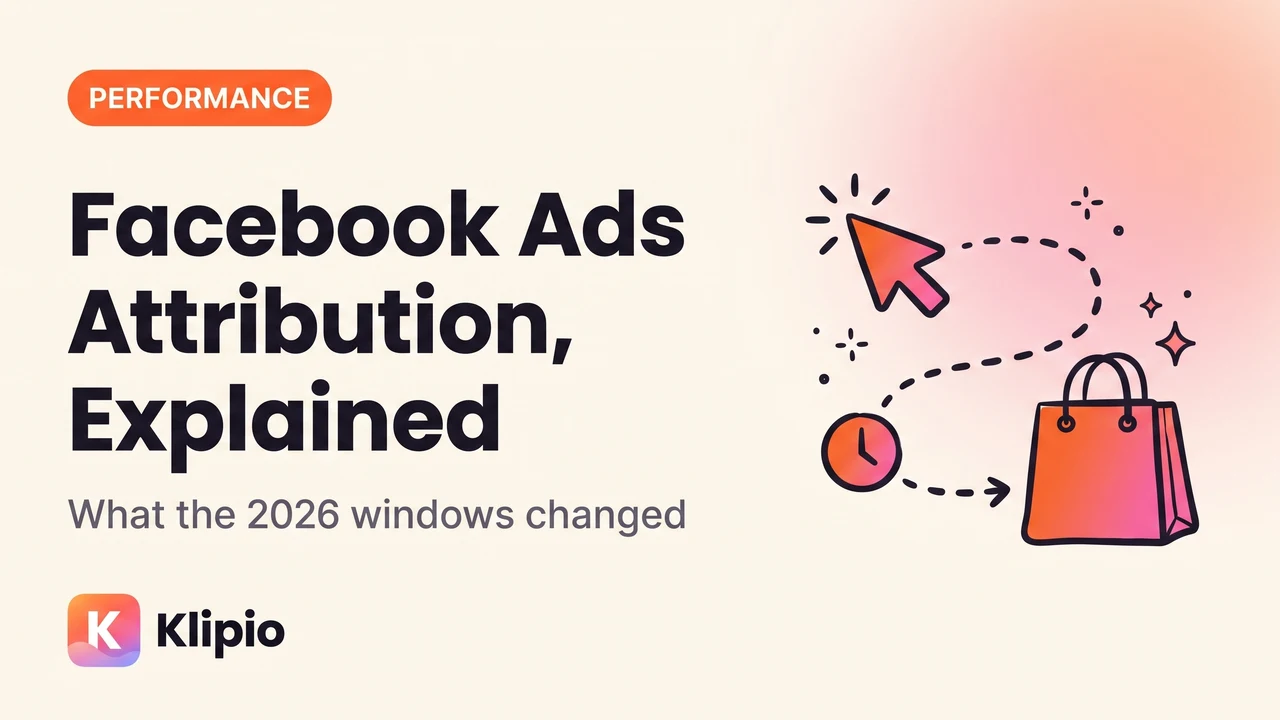
Facebook ads attribution is the rule Meta uses to decide whether a sale counts as coming from your ad — specifically, how long after someone clicks or views your ad a purchase still gets credited to it. The current default window is 7-day click, 1-day view, and it directly controls the ROAS number you see in Ads Manager.
This isn't a settled topic. Meta changed the windows twice in the first few months of 2026, and neither change touched your actual sales — only what got reported.
What Is Facebook Ads Attribution?
Attribution is the lookback window Meta applies before crediting a conversion to an ad. If someone clicks your ad on Monday and buys on Thursday, a 7-day click window counts that sale. A 1-day click window would not.
Meta offers a small set of windows to combine: 1-day click, 7-day click (the default), and 1-day view. A 28-day click window used to exist as a standard option; it was pulled back to comparison-only territory years ago, and its current status is inconsistent enough across sources that you should treat it as unavailable unless you see it live in your own account.
What's the Current Default Attribution Window?
The default is 7-day click, 1-day view. A purchase counts toward your ad if it happens within 7 days of someone clicking the ad, or within 1 day of someone viewing (being served an impression of) the ad without clicking.
That view-based leg is why Meta-reported ROAS usually runs hotter than what your store's own analytics show. Someone can scroll past your ad, buy for an unrelated reason the next day, and Meta will still claim partial credit.
| Window | What it counts | Status in 2026 |
|---|---|---|
| 1-day click | Purchase within 1 day of a click | Available, narrower than the default |
| 7-day click | Purchase within 7 days of a click | Default |
| 1-day view | Purchase within 1 day of a view/impression, no click | Default (paired with 7-day click) |
| 7-day view | Purchase within 7 days of a view | Removed Jan 12, 2026 |
| 28-day view | Purchase within 28 days of a view | Removed Jan 12, 2026 |
| 28-day click | Purchase within 28 days of a click | Flagged inconsistent — verify live |
What Changed on January 12, 2026?
Meta permanently removed the 7-day view and 28-day view attribution windows from both Ads Manager and the API on January 12, 2026. If your account used either window, historical unique-click and hourly data is now capped at 13 months back, and any API call still requesting the deprecated parameters returns an empty result silently — no error, just nothing.
The practical effect: accounts that leaned on view-based windows saw reported conversions drop roughly 15-40% overnight. Nothing about actual sales changed. This was a reporting artifact, not a performance collapse.
What Changed on March 3, 2026?
Around March 3, 2026, Meta narrowed the definition of a "click" for attribution purposes on web and in-store conversion campaigns. Only a genuine outbound link click now counts as a click-through. Likes, comments, shares, saves, and short video engagement got moved into a separate bucket called "engage-through," attributed on a 1-day window with a tightened video-view threshold of 5 seconds.
The reported default string is inconsistent across sources at the time of writing — some show "7-day click, 1-day view," others show "7-day click, 1-day engage-through, 1-day view." Verify the exact label live in your own Ads Manager before you quote it to a client or teammate.
- 1Ad servedimpression or view logged
- 2Click or engagelink click vs like/comment/share
- 3Window applies7-day click OR 1-day view/engage
- 4Purchase happensinside or outside the window
- 5Credit assignedcounted or not counted in Ads Manager
Why Won't Ads Manager Match GA4 or Shopify?
Because the three systems are answering different questions on different clocks. Ads Manager uses last-touch-within-window logic on Meta's own attribution setting. GA4 typically uses its own model and cookie rules. Shopify counts an order the moment it's actually placed, with no lookback window at all.
Two structural reasons make this permanent, not a bug to fix:
Meta over-counts. Multiple channels can each claim the same sale under their own attribution rules — Meta, Google, and your email platform can all report the same order as theirs. Ads Manager also includes modeled conversions to fill gaps where a pixel or CAPI signal didn't fire cleanly.
Meta under-counts long sales cycles. iOS App Tracking Transparency plus the shrinking attribution window means a purchase that happens 10 days after a click, inside a real buying journey but outside the 7-day window, never gets credited to the ad that started it.
How Do I Check My Attribution Setting?
Attribution windows live at the ad set level in Ads Manager, inside the optimization and delivery settings when you're building or editing an ad set. The setting you choose there is also what determines the reporting window for that ad set's columns.
Cost per result is not the same thing as CPA unless your optimized result is a purchase — worth checking before you compare attribution-driven cost swings across campaigns with different objectives. For the full breakdown of which Ads Manager columns to trust and which to ignore, see our guide to reading Meta ads KPIs.
Should I Change My Attribution Window?
Generally, leave it on the 7-day click, 1-day view default unless you have a specific reason to change it. Because attribution is an optimization input, switching windows mid-campaign can shift who Meta's algorithm targets, not just how the report reads afterward.
The cases where it's worth revisiting: a long sales cycle where 7 days genuinely undercounts real buyers, or a need to compare Meta's numbers against another platform that only reports click-based conversions. Our walkthrough on measuring Facebook ad performance covers how to build a reporting stack that doesn't depend on any single platform's attribution string being right.
Where Does Competitor Research Fit Into an Attribution-Confused World?
None of this changes what you can learn by watching what competitors actually run. Attribution windows affect how a brand reports its own results privately — they say nothing about whether an ad is working. The public signal that survives all of this noise is simple: is the ad still running.
An ad a competitor keeps paying for through multiple attribution changes, algorithm updates, and reporting shakeups is still earning its budget. That's ad longevity, and it's visible to anyone in the free Meta Ad Library regardless of what window their internal dashboard uses.
This is the gap our own tool, Klipio, is built around — full disclosure, it's ours. Klipio is Meta-only ad intelligence: it watches competitors' live Meta ads, surfaces which ones have run longest (the closest public proxy for "this is actually profitable"), and turns the winning angles into on-brand creative briefs. The free Chrome extension downloads Ad Library ads directly; paid plans that add the angle-mining and creative generation start at $79/mo.
FAQ
What is the default Facebook ads attribution window in 2026?
The current default is 7-day click, 1-day view: a purchase counts if it happens within 7 days of someone clicking your ad, or within 1 day of a view or impression with no click.
Why did my Facebook ad conversions drop suddenly in January 2026?
Meta permanently removed the 7-day view and 28-day view attribution windows on January 12, 2026. Accounts that relied on view-based attribution saw reported conversions drop roughly 15-40% as a reporting artifact — actual sales performance didn't change.
Does a like or comment on my ad count as a click for attribution?
No, not since the March 2026 redefinition. Only a real outbound link click counts as a click-through now; likes, comments, shares, and short video views fall into a separate 1-day "engage-through" bucket instead.
Why doesn't my Meta ROAS match my Shopify or GA4 revenue?
Ads Manager, GA4, and Shopify each use different attribution logic and different clocks to decide whether a sale counts. Meta tends to over-count (multiple channels claim the same sale) while also under-counting long sales cycles that fall outside its shrinking attribution window — they were never designed to reconcile 1:1.
Is cost per result the same as CPA in Meta Ads Manager?
Only when your campaign's optimized result is a purchase. For any other objective, like leads, traffic, or engagement, cost per result measures a different action entirely, so don't read it as your acquisition cost.
Should I switch my ad set to a shorter or longer attribution window?
Stick with the 7-day click, 1-day view default unless you have a specific reason, like a long sales cycle Meta is undercounting. Attribution is an optimization input, so changing it can shift who the algorithm targets, not just how the report reads.
The Klipio extension adds a download button to every ad in the Meta Ad Library: one click per ad, or bulk-save a whole search as a ZIP with a searchable swipe file inside. Free, no sign-up.
Get the free Ad Library downloaderKlipio reads a competitor's live Meta ads, ranks them by how long they have been running — the honest signal that an ad is profitable — and turns the winning angle into on-brand creative for your own brand. 3-day free trial.
Start free — 3-day trial →