
Facebook Ad Creative Testing: A Framework That Works
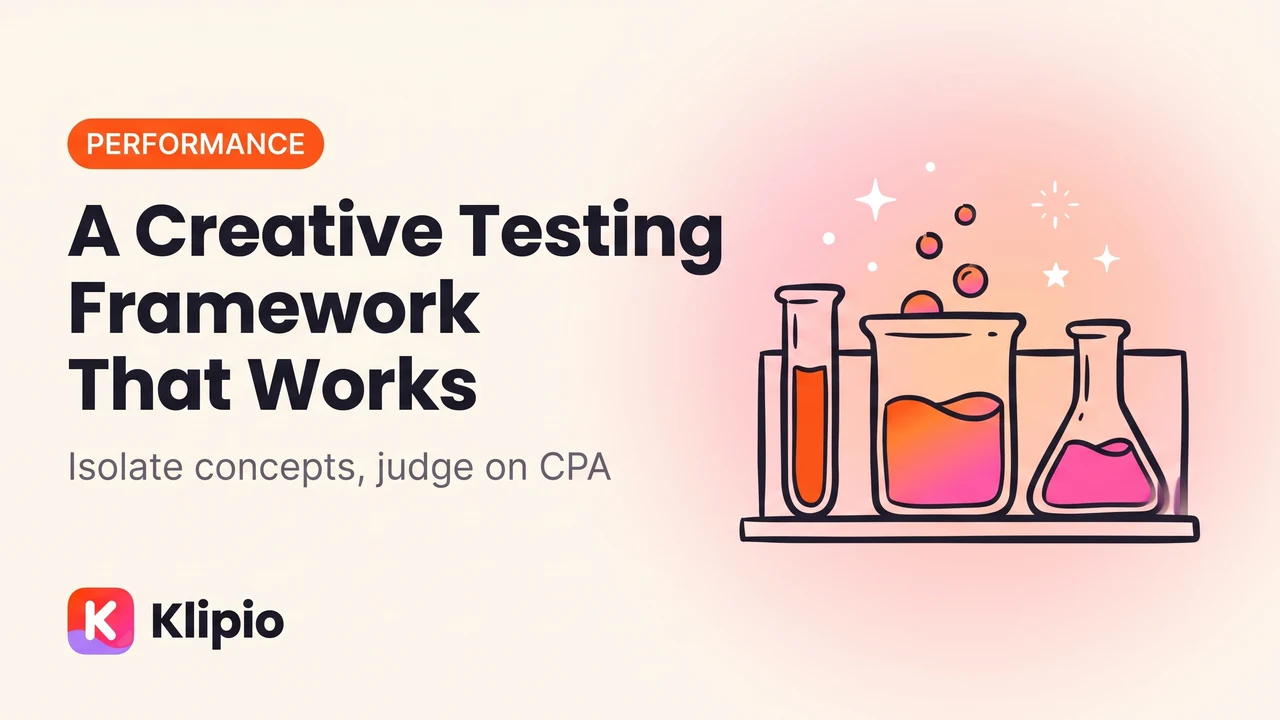
Facebook ad creative testing works when you isolate what you're testing, run it with equal budget per variant, and judge the result on cost per result or ROAS instead of engagement. Get any one of those three wrong and the "winner" you pick is usually noise wearing a good hook rate.
Here's the full framework: how to structure a test, when to use ABO vs CBO, how many conversions to wait for, and where to keep the pipeline fed once a test is done.
What Does a Facebook Ad Creative Testing Framework Actually Need?
A working framework for facebook ad creative testing has four parts: an isolated test structure, a budget setup that doesn't let the algorithm cheat, a sample-size floor before you trust a result, and a judging metric that isn't vanity engagement.
Skip any one part and you'll draw a false conclusion — usually crowning a hook that gets clicks but never converts.
- 1Isolate the testDedicated campaign, concept tests separate from variation tests
- 2Set equal budget per variantABO for new concepts so nothing gets starved early
- 3Run to ~50 conversions per variantThe floor for a confident read, not a guess
- 4Judge on CPA and ROASHook rate and link CTR inform, they don't decide
- 5Move the winner to CBOScale what's proven; testing structure stays separate
How Do You Isolate a Creative Test on Meta Ads?
Isolation means separating what you're actually trying to learn. A concept test asks "does this angle work at all?" A variation test asks "which hook, headline, or thumbnail performs best on an angle we already know works?" Mixing those two questions in one ad set muddies both answers.
Run concept tests in a dedicated testing campaign or ad set, away from your scaling campaigns. That keeps a rough idea from getting buried under proven winners, and keeps a scaling campaign from getting dragged down by an unproven concept.
ABO vs CBO Testing: Which Should You Use?
This is the most common structural mistake in creative testing meta ads: running a test inside a Campaign Budget Optimization (CBO) ad set and expecting a fair read. CBO shifts spend toward whichever ad is winning early — great for scaling, terrible for a test, since one early hook can starve the others before they've spent enough to prove anything.
Ad Set Budget Optimization (ABO), with an equal budget assigned to each variant, is the standard for testing. Every variant gets a fair shot regardless of how it's performing hour one.
| ABO (equal budget/variant) | CBO | |
|---|---|---|
| Best for | New concept tests, isolating a fair read | Scaling a proven winner |
| Budget behavior | Fixed per variant — no favoritism | Shifts to the current best performer automatically |
| Risk if misused | Wastes spend if you never scale a winner out | Kills weaker variants before they've had enough spend to prove out |
| Post-Andromeda variant | — | Testing 4-6 hook variations inside one CBO/Advantage+ ad set, with a per-ad spend floor |
One newer pattern: since Andromeda, hook-level testing often moves inside a single CBO or Advantage+ ad set — 4-6 hook variations, with a per-ad spend floor so delivery can't starve one early. That's a fast way to test hooks, but it's still a variation test, not a concept test. Save the dedicated ABO structure for genuinely new angles.
The short version: no proven concept yet means a dedicated ABO test with equal budget per variant. A proven concept you're testing hooks on means a CBO or Advantage+ ad set with 4-6 hook variants and a per-ad spend floor. A concept that's already proven means CBO to scale it, outside the testing structure entirely.
How Many Conversions Do You Need Before Calling a Winner?
Roughly 50 conversions per variant is the floor for a confident read. Below that, treat any lead as directional — worth noting, not worth killing the other variants over.
This matters because early data lies convincingly. A variant can look like a clear winner at 8 conversions and flip completely by 50, especially on ecommerce accounts where a handful of purchases can swing cost per result wildly in either direction.
What's a Hook Matrix, and What Is the 3-3-3 Framework?
Both are ways to structure a test batch instead of throwing ads into an ad set ad-hoc. A hook matrix crosses hooks against angles — five hooks × two angles gives you ten distinct ads, each one a clean combination you can trace a result back to. The 3-3-3 framework goes a layer deeper: three concepts, each with three format variations, each tested with three hooks.
Either structure exists to answer one question cleanly: when an ad wins, do you know if it won because of the angle, the hook, or the format? Ad-hoc testing usually can't answer that.
One proven angle can typically support 20 or more hook variations before it's exhausted — the angle is the expensive part to find, hooks are comparatively cheap to iterate once one works.
Should You Judge Winners on Engagement or CPA?
Judge on cost per result and ROAS, not hook rate, hold rate, or link CTR alone. Meta's delivery system can and will pour budget into an ad with a great hook rate and a mediocre — or bad — cost per result, because a high hook rate looks like a win to the optimization signal even when it doesn't convert.
Two ads can post the exact same hook rate and produce very different ROAS. Always read hook rate together with hold rate and the downstream cost number, never hook rate alone.
Set up the gate as two checks together: a hook-rate gate for upper-funnel awareness campaigns, and a cost-per-result gate that has to pass regardless. Here's why that second gate matters:
Ad A: hook rate 35%, cost per result $22, and the optimized result is a purchase, so cost per result here equals CPA: $22 CPA. Ad B: hook rate 34% — almost identical — but cost per result $41, also on purchases: $41 CPA.
By engagement alone these two ads look like a tie. By the metric that actually pays the bills, Ad A is nearly twice as efficient. That gap is exactly what an engagement-only read misses.
Hook rate and hold rate aren't native Ads Manager columns — you build them as custom metrics. Setting up custom columns in Meta Ads Manager walks through the formula builder, including the gotcha where a formula already multiplied by 100 doubles up under Percentage format.
Iteration vs Net-New: Where Should New Creative Come From?
Once a concept wins, most of what you produce next shouldn't be brand-new ideas — it should be iteration on what's already proven. A useful split: roughly 60% direct iteration on winners (new hooks, new headlines on the same angle), 30% format remixes (the same angle rebuilt as UGC, static, or carousel), and 10% genuinely net-new concepts.
That 10% is the part that actually keeps the pipeline from going stale — it's also the hardest slice to fill, because it can't come from iterating on what you already have.
Where Do New Testing Angles Come From?
The iteration and format-remix slices are straightforward — you're working off a proven concept. The net-new 10% is the bottleneck for most accounts, because genuinely new angles don't come from staring at your own dashboard.
One honest source: what competitors are still running. The Meta Ad Library shows no spend data for ordinary ads, but every card shows a "Started running on" date, and an ad still live after 60-90 days has survived enough budget reviews to be a real signal. Reading how ad longevity spots winners is the fastest way to learn what "long enough" means before you trust it. It's a companion read to finding winning ad angles, and once a test starts slipping, fixing creative fatigue covers the leverage order for what to change first.
Disclosure: Klipio, which I work on, is built around exactly this gap. It's a Meta-only ad intelligence tool: it watches specific competitors' live Meta ads, surfaces which ones have run longest, and distills the repeatable angle behind them into a brief you can test in your own framework, on-brand. Paid plans start at $79/mo. If you'd rather pull the raw ads yourself first, our free Meta Ad Library Downloader adds a one-click download button to any Ad Library ad, plus a bulk mode that exports a whole competitor's active ads into one ZIP with a searchable swipe board — no account, no watermark, everything runs in your own browser.
FAQ
What is the best framework for testing Facebook ad creative?
Isolate concept tests from variation tests in a dedicated structure, use ABO with equal budget per variant for new concepts, wait for roughly 50 conversions per variant, and judge winners on cost per result or ROAS rather than engagement. A hook matrix or the 3-3-3 structure (3 concepts × 3 variations × 3 hooks) keeps the batch organized enough to trace a win back to its actual cause.
Should I use ABO or CBO to test new Facebook ad creative?
Use ABO — equal budget per variant — for testing a genuinely new concept, so Meta's delivery can't starve a variant before it's had a fair chance to spend. Use CBO once you've already got a proven winner and you're scaling it, or when you're testing 4-6 hook variations inside one CBO or Advantage+ ad set with a per-ad spend floor, which is a variation test, not a concept test.
How many conversions do I need before trusting a creative test result?
Roughly 50 conversions per variant is the floor for a confident read. Fewer than that — say 5-10 — is directional at best; a result that looks decisive that early can flip completely by the time it reaches 50.
Should I judge a winning ad on hook rate or CPA?
CPA and ROAS, not hook rate alone. Meta's delivery can favor an ad with strong engagement and a poor cost per result, and two ads with near-identical hook rates can land on very different ROAS. Use hook rate as an early upper-funnel signal, but let cost per result or ROAS make the final call.
What's the difference between a hook matrix and the 3-3-3 testing framework?
A hook matrix crosses a set of hooks against a set of angles — for example 5 hooks × 2 angles for 10 distinct ads. The 3-3-3 framework adds a format layer: 3 concepts, each in 3 format variations, each tested with 3 hooks. Both exist to keep a test batch structured enough that you know which variable caused a result.
Where should new testing angles come from once I run out of ideas?
A repeatable pipeline needs roughly 10% genuinely net-new concepts on top of iteration and format remixes, and the fastest honest source for those is what competitors are still running weeks or months after launch — ad longevity in the Meta Ad Library is the closest public signal to "this is actually working" that you'll find outside someone's ad account.
The Klipio extension adds a download button to every ad in the Meta Ad Library: one click per ad, or bulk-save a whole search as a ZIP with a searchable swipe file inside. Free, no sign-up.
Get the free Ad Library downloaderKlipio reads a competitor's live Meta ads, ranks them by how long they have been running — the honest signal that an ad is profitable — and turns the winning angle into on-brand creative for your own brand. 3-day free trial.
Start free — 3-day trial →